Har Ki Pauri Ganga Aarti Timing: Morning & Evening
The most common question we get from families planning Haridwar isn’t about hotels or trains. It’s “what time is the aarti?” The honest answer is that there’s no fixed clock time. The Har Ki Pauri Ganga Aarti timing follows sunrise and sunset, so it moves by more than an hour and a half between June and December. Get it wrong and you either wait in the cold for an hour, or arrive to a ghat so full you can only see the lamps from a distance.
This guide covers both aartis, the morning Mangala Aarti and the evening Shringar Aarti. It includes a month-by-month timing table, where to stand, how early to arrive on different days, and the mistakes we see first-time visitors make. It’s written by our team in Uttarakhand, who plan Haridwar visits around the aarti every week.
Quick Answer: The Ganga Aarti at Har Ki Pauri happens twice daily, at sunrise and sunset. In summer, the morning aarti is roughly 5:00–6:50 AM and the evening aarti roughly 5:30–7:00 PM. In winter, the morning aarti is around 6:30–7:00 AM and the evening aarti around 5:00–5:30 PM. Exact times shift with the sun, so arrive 45–60 minutes early for the evening aarti.
Key Takeaways
- There are two aartis daily: the Mangala Aarti at sunrise and the Shringar Aarti at sunset.
- Timings follow the sun, so the evening aarti is earliest in December and latest in June–July.
- The evening aarti is the famous one and much more crowded. The morning aarti is quieter.
- The aarti is held at Brahma Kund, the most sacred spot within Har Ki Pauri.
- Arrive 45–60 minutes early on normal evenings, and 2 hours or more on festival days.
- Entry is free. Shri Ganga Sabha volunteers collect voluntary donations.
What Time Is the Ganga Aarti at Har Ki Pauri?
The Ganga Aarti at Har Ki Pauri is held twice a day, at sunrise and at sunset. Summer evenings start roughly between 5:30 and 7:00 PM, and winter evenings roughly between 5:00 and 5:30 PM.
The morning ritual is the Mangala Aarti and the evening one is the Shringar Aarti. Both are organised by Shri Ganga Sabha, the body that has managed the ghat’s rituals since the aarti tradition here was formalised in 1916, credited to Pandit Madan Mohan Malviya.
Because the timing is tied to the sun rather than the clock, the start time changes almost every week. Here are the seasonal ranges most local sources agree on:
| Season | Morning aarti (Mangala) | Evening aarti (Shringar) |
|---|---|---|
| Summer (roughly March–October) | About 5:00–6:50 AM | About 5:30–7:00 PM |
| Winter (roughly November–February) | About 6:30–7:00 AM | About 5:00–5:30 PM |
Approximate. Timings follow sunrise and sunset and can shift by 15–30 minutes. Confirm with your hotel or at the ghat on the day.
SnazzyTrips Insight: Hotels near Har Ki Pauri usually know the exact aarti time for that day. Ask at check-in rather than relying on a timing you found online weeks earlier. That one question decides whether you get a place on the steps or watch from the back of the crowd.
Month-by-Month Har Ki Pauri Ganga Aarti Timing
The evening aarti moves by about two hours across the year, from around 5:15 PM in December to around 7:15 PM in late June. The table below estimates the start time for each month from Haridwar’s average sunrise and sunset.
Most websites only give “summer” and “winter” timings. That isn’t enough if you’re arriving in March or October, when the timing sits between the two. Use this table to plan your day, then confirm locally.
| Month | Morning aarti (approx.) | Evening aarti (approx.) |
|---|---|---|
| January | 6:45–7:15 AM | 5:30–5:45 PM |
| February | 6:30–7:00 AM | 5:50–6:10 PM |
| March | 6:00–6:30 AM | 6:10–6:30 PM |
| April | 5:30–6:00 AM | 6:30–6:50 PM |
| May | 5:00–5:30 AM | 6:50–7:10 PM |
| June | 5:00–5:20 AM | 7:00–7:20 PM |
| July | 5:10–5:30 AM | 7:00–7:20 PM |
| August | 5:30–5:50 AM | 6:40–7:00 PM |
| September | 5:45–6:05 AM | 6:10–6:30 PM |
| October | 6:00–6:20 AM | 5:40–6:00 PM |
| November | 6:20–6:45 AM | 5:15–5:30 PM |
| December | 6:45–7:10 AM | 5:10–5:30 PM |
These are estimates based on average sunrise and sunset in Haridwar, not official timings. The actual start can vary by 15–30 minutes. Always confirm on the day.
The practical takeaway: in winter, an evening aarti that starts around 5:15 PM means leaving your hotel around 4:15 PM, while it’s still daylight. Many families who don’t know this plan a relaxed late-afternoon temple visit and miss the aarti entirely.
Morning vs Evening Aarti: Which Should You Attend?
Attend the evening Shringar Aarti for the full spectacle of lamps, chants and floating diyas. Attend the morning Mangala Aarti if you want a calmer, more personal experience with far fewer people.
| Factor | Morning aarti (Mangala) | Evening aarti (Shringar) |
|---|---|---|
| Crowd size | Small to moderate | Large every day, very large on weekends |
| Atmosphere | Quiet, devotional | Grand, energetic, emotional |
| Light | Dawn light on the river | Lamps glowing against the dusk |
| Diya floating | Fewer people float diyas | Hundreds of leaf-boat diyas on the water |
| Finding a spot | Easy, even close to Brahma Kund | Needs early arrival |
| Best for | Seniors, quiet prayer, photographers who want space | First-time visitors, families, the full experience |
| Combines well with | The holy dip, which is calmer in the morning | Evening shopping and food near the ghat |
SnazzyTrips Recommends: If you have two evenings in Haridwar, attend the evening aarti on the first and the morning aarti plus your holy dip on the second day. You’ll see both moods of Har Ki Pauri, and the morning dip is far more comfortable without the crowd.
On a one-night trip, choose the evening aarti. It’s the reason most people come to Har Ki Pauri, and the morning aarti, beautiful as it is, can’t replace it.
What Happens During the Ganga Aarti?
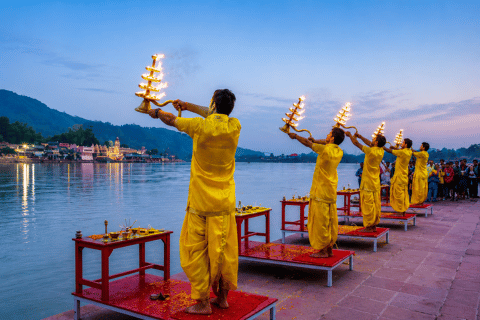
The aarti lasts roughly 20–45 minutes depending on the day, though the whole gathering, from chanting before to diyas after, takes about an hour. Priests wave large multi-tiered brass lamps towards the river while bells, conches and the Ganga aarti hymn fill the ghat.
The sequence usually goes like this:
1. Gathering and chanting (before the aarti). Devotees fill the steps, and bhajans and announcements play over the speakers. Shri Ganga Sabha volunteers move through the crowd collecting voluntary donations, which fund the aarti and the Sabha’s other work.
2. The aarti itself. Priests at Brahma Kund raise and circle the lit lamps towards the Ganga in unison. The crowd sings along, and bells and conches mark the rhythm.
3. Diya offering. After the aarti, devotees float leaf-boat diyas with flowers on the current. On busy evenings, the river fills with hundreds of small lights drifting downstream.
4. Dispersal. The crowd leaves quickly in the 10–15 minutes after the aarti ends. This is the most crowded moment on the steps and bridges.
Brahma Kund, where the aarti is performed, is believed to be the spot where drops of amrit fell during the Samudra Manthan. A stone at the ghat is believed to bear Lord Vishnu’s footprint, which gives Har Ki Pauri its name, “the steps of Hari”.
Where Is the Best Place to Watch the Aarti?
For the closest view, sit on the steps at Brahma Kund. For the full panorama with less pushing, watch from Malviya Dwip, the island opposite the main ghat, or from the steps on the far bank.
| Viewing spot | View | Crowd | Best for |
|---|---|---|---|
| Brahma Kund steps | Closest, right beside the priests | Densest | Devotees who want to be at the centre |
| Main ghat steps on either side | Clear view of the lamps | Heavy | Families arriving 45–60 minutes early |
| Malviya Dwip (island opposite) | Wide view across the water | Moderate | Seniors, photographers, a calmer experience |
| Footbridges over the river | Elevated, full panorama | Moving crowd, police may keep it clear | A quick look, not for sitting |
| Far bank steps | The whole ghat lit up | Lighter | Anyone who prefers space over closeness |
SnazzyTrips Insight: For families with grandparents, we usually suggest Malviya Dwip. You see the whole aarti across the water, there’s less jostling, and leaving afterwards is much easier than climbing up the main steps through the departing crowd.
A note for international and non-Hindu visitors: Shri Ganga Sabha’s rules have historically restricted entry to the main Har Ki Pauri ghat area for non-Hindus. Visitors can watch the aarti from Malviya Dwip and the opposite bank, which offer some of the best views anyway. Check the current rules locally.
How Early Should You Reach Har Ki Pauri?
Reach 45–60 minutes before the evening aarti on a normal weekday, 75–90 minutes on weekends, and 2 hours or more on festival days. For the morning aarti, 20–30 minutes early is usually enough.
| Day type | Evening aarti: arrive | Morning aarti: arrive |
|---|---|---|
| Normal weekday | 45–60 minutes early | 20–30 minutes early |
| Saturday, Sunday, long weekend | 75–90 minutes early | 30 minutes early |
| Major festival or snan day | 2+ hours early, or watch from across the river | 45–60 minutes early |
| Kanwar Yatra (Shravan) | Expect heavy crowds and restrictions | Morning is the better choice |
If you can’t arrive early, don’t push forward into the main steps. Go straight to Malviya Dwip or the far bank, where there’s usually still room and you’ll see more of the aarti than from the back of the main crowd.
Har Ki Pauri vs Rishikesh vs Varanasi: How the Aartis Compare
Har Ki Pauri has the most traditional and intense Ganga Aarti in Uttarakhand. Rishikesh’s aartis at Triveni Ghat and Parmarth Niketan are calmer and more musical, and Varanasi’s Dashashwamedh aarti is a more elaborate, staged ceremony often watched from boats.
| Factor | Har Ki Pauri, Haridwar | Triveni Ghat / Parmarth Niketan, Rishikesh | Dashashwamedh Ghat, Varanasi |
|---|---|---|---|
| Setting | Fast-flowing Ganga leaving the hills | Wider river with hills around | Wide, slow river on the plains |
| Feel | Traditional, devotional, intense | Calmer, bhajan-led, often with ashram residents | Choreographed, theatrical |
| Crowd | Very large daily | Moderate | Very large, many tourists |
| Viewing | Steps, island, opposite bank | Ghat steps, seated rows at Parmarth | Steps and boats on the river |
| Diya offering | A central part of the ritual | Common | Common |
| Best for | Pilgrims, first Ganga Aarti experience | A gentler evening, yoga travellers | Seeing the grandest staged ceremony |
Haridwar and Rishikesh are only about 25 km apart, so many families see both on the same trip. Our Rishikesh tour packages usually include the Triveni Ghat or Parmarth Niketan aarti on a separate evening, which is a nice contrast to Har Ki Pauri.
Days When the Aarti Is Busier or Different
The aarti happens every single day of the year, but certain dates bring much bigger crowds. Some periods also change what you’ll see at the ghat.
Major snan festivals: Makar Sankranti, Mauni Amavasya, Basant Panchami, Ganga Dussehra, Kartik Purnima, Somvati Amavasya and Baisakhi bring very large crowds, plus police traffic diversions in the town.
Kanwar Yatra (Shravan month, usually July–August): Lakhs of kanwariyas come to collect Ganga jal. Roads into Haridwar are heavily restricted, and evening crowds at the ghat are among the year’s largest.
Kumbh and Ardh Kumbh: During a Kumbh, Har Ki Pauri may be reserved for akhara processions for part of the major bathing days. Visitors should follow the mela administration’s ghat arrangements.
Annual canal closure: For about a month each year, the Upper Ganga Canal flowing past Har Ki Pauri is closed for maintenance and the water level at the ghat drops sharply. This usually happens around Dussehra–Diwali. The ghat looks very different then, so check the dates if a full river matters to you.
Weekends and long weekends: Delhi-NCR traffic fills Haridwar every weekend. The difference between a Wednesday and a Sunday evening at Har Ki Pauri is huge.
SnazzyTrips Insight: When guests can choose their dates freely, we schedule the Haridwar evening on a weekday and keep weekends for the hills. The aarti is the same every evening; the crowd isn’t.
Haridwar is the gateway to the whole Garhwal region, so many families plan their aarti evening at the start of a longer hill trip. Our Garhwal tour packages often begin with exactly this: a night near Har Ki Pauri before heading into the mountains.
Mistakes First-Time Visitors Make
The most common mistake is using a fixed “7 PM” timing found online, which is only right in early summer. Here are the others we see often:
- Arriving at the published start time. By then the steps are full. Arrive 45–60 minutes early.
- Planning a temple visit for late afternoon in winter. The winter aarti starts around 5:00–5:30 PM, so leave by about 4:15 PM.
- Parking close to the ghat. Vehicles are restricted near Har Ki Pauri. Park at a designated parking area and walk, or take an e-rickshaw.
- Carrying valuables. Crowds are dense. Leave jewellery and extra cash at the hotel.
- Pushing to the front at the last moment. It’s unsafe and rarely works. Go to Malviya Dwip instead.
- Accepting “special puja” offers without asking the price. If you want a personal puja, agree the amount clearly first, or arrange one through your hotel or travel planner.
- Leaving the instant the aarti ends. That’s when the crowd surges. Wait 10–15 minutes and leave with the second wave.
- Booking a hotel far away to save money. If the aarti is the main reason for your visit, a hotel within walking distance saves time, money and stress on transport.
Tips for Seniors, Children and Photographers
Seniors should attend the morning aarti or watch the evening one from Malviya Dwip. Children need a firm meeting point, and photographers get the best light about 15 minutes after sunset.
For senior citizens
- Choose a hotel within 5–10 minutes’ walk of the ghat to avoid long walks after dark.
- Carry a small foldable cushion; the stone steps get cold, especially from November to February.
- From December to February, evenings near the river can drop to around 5–8°C. Take a shawl and cap even if the afternoon felt warm.
- If walking or crowds are difficult, the morning aarti is the better option.
Families who prefer quieter places often finish their trip in calmer hill towns. Ranikhet, with its flat cantonment roads, is a popular choice with older travellers for exactly that reason.
For children
- Write your phone number on a card in each child’s pocket.
- Agree a fixed meeting point that’s easy to recognise, such as the clock tower at Har Ki Pauri.
- Hold hands firmly during the crowd surge after the aarti.
For photographers
- The best light comes 10–20 minutes after sunset, when the sky still has colour and the lamps glow.
- Shoot from Malviya Dwip or the far bank for wide frames of the ghat.
- Avoid flash, and keep your gear compact. Tripods are impractical on crowded steps.
SnazzyTrips Recommends: If the morning light over the Ganga is what you love, you’ll also love Himalayan sunrises. Families who enjoy the dawn aarti often add a few days in Kausani, known for its wide sunrise views of the snow peaks on clear mornings.
How to Get to Har Ki Pauri for the Aarti
Har Ki Pauri is about 2.5–3 km from Haridwar Railway Station and close to the main bus stand, roughly a 10–15 minute e-rickshaw ride. For the last stretch, you’ll walk, because vehicles are restricted near the ghat.
From Haridwar Railway Station: Take an e-rickshaw or auto towards Har Ki Pauri, then walk the final few hundred metres.
From Dehradun’s Jolly Grant Airport: About 35–40 km, taking 1–1.5 hours by road. Allow extra time on weekend evenings.
By car: Use the designated parking areas around the ghat, such as the large parking at Pantdweep across the river, and walk in. Expect diversions on festival days.
From Rishikesh: About 25 km, taking 45 minutes to 1.5 hours depending on traffic. If you’re coming for the evening aarti, leave Rishikesh at least 2.5 hours before sunset.
| From | Distance | Usual time | Last stretch |
|---|---|---|---|
| Haridwar Railway Station | 2.5–3 km | 10–15 min | Walk |
| Haridwar bus stand | About 2–3 km | 10–15 min | Walk |
| Jolly Grant Airport, Dehradun | 35–40 km | 1–1.5 hours | Walk from parking |
| Rishikesh | About 25 km | 45 min – 1.5 hours | Walk from parking |
| Delhi | About 220 km | 5–6 hours | Walk from parking |
Times are approximate and depend on traffic, especially on weekends and festival days.
A weekend trip from Delhi often combines Haridwar with a short hill stay. Lansdowne is one of the closest quiet hill towns in Garhwal, and Mussoorie is a classic pairing reached via Dehradun.
How SnazzyTrips Can Help
SnazzyTrips is a local Uttarakhand-based DMC operating since 2003, with teams in Haldwani and Dehradun. For Haridwar trips, we focus on what actually affects the aarti: hotels within walking distance of the ghat, pickups timed to your train or flight, and a coordinator who knows that day’s aarti time and crowd situation.
If you’d like your Haridwar visit planned around the aarti, see our Haridwar tour packages, or ask us for a Haridwar stay close to the ghats as part of a longer trip. Families travelling further can explore Kumaon tour packages for the lake and hill towns of the east. To learn more about how we work, visit our local Uttarakhand travel team.
Frequently Asked Questions
1. What is the Har Ki Pauri Ganga Aarti timing in the evening?
The evening aarti starts around sunset: roughly 5:30–7:00 PM in summer and 5:00–5:30 PM in winter. Confirm the exact time locally on the day.
2. What time is the morning Ganga Aarti at Har Ki Pauri?
The morning Mangala Aarti is at sunrise: roughly 5:00–6:50 AM in summer and 6:30–7:00 AM in winter.
3. How long does the Ganga Aarti at Har Ki Pauri last?
The aarti itself lasts roughly 20–45 minutes. With chanting before and diya offerings after, plan about an hour at the ghat.
4. Is there an entry fee for the Ganga Aarti?
No, the aarti is free to attend. Shri Ganga Sabha volunteers collect voluntary donations during the gathering.
5. How early should I reach for the evening aarti?
Arrive 45–60 minutes early on weekdays, 75–90 minutes on weekends, and 2 hours or more on festival days.
6. Which is better, the morning or evening Ganga Aarti?
The evening aarti is the grander experience and better for first-time visitors. The morning aarti is quieter and better for seniors or anyone who wants space.
7. Where is the best place to watch the aarti?
Brahma Kund steps give the closest view. Malviya Dwip, the island opposite, gives a wide view with fewer crowds.
8. Does the Ganga Aarti happen every day?
Yes, twice a day, every day of the year, including in winter and the monsoon.
9. Is the Har Ki Pauri aarti suitable for senior citizens?
Yes, with planning. Choose a hotel close to the ghat, watch from Malviya Dwip or attend the morning aarti, and carry warm layers in winter.
10. What should I wear to the Ganga Aarti?
Modest clothing covering shoulders and knees, and slip-on footwear. In winter, carry a shawl or jacket, as evenings by the river get cold.
11. Can I combine the Har Ki Pauri aarti with a hill trip?
Yes. Haridwar is the starting point for most Garhwal trips. Many families continue to Mussoorie or Auli, or head east towards Kumaon towns like Mukteshwar and Binsar.
12. Is the river always full at Har Ki Pauri?
No. For about a month each year, usually around Dussehra–Diwali, the canal at Har Ki Pauri is closed for maintenance and the water level drops. Check the dates if a full river matters to you.
Planning a longer trip after Haridwar?
In winter, families who want snow after the aarti often head to Auli tour packages in the higher Garhwal Himalaya. Those who want remote mountain villages and big Himalayan views choose Munsiyari in eastern Kumaon. Snowfall is never guaranteed in either place.
Travel Packages