Chopta Travel Agent / Tour Operator / Agency
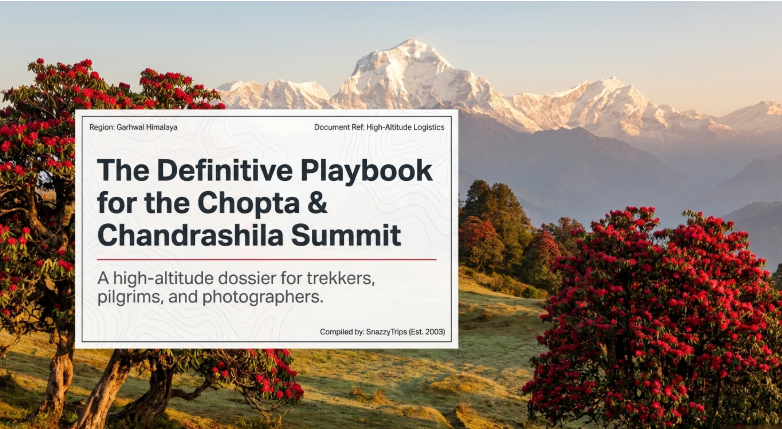
Chopta Travel Agent / Tour Operator / Agency
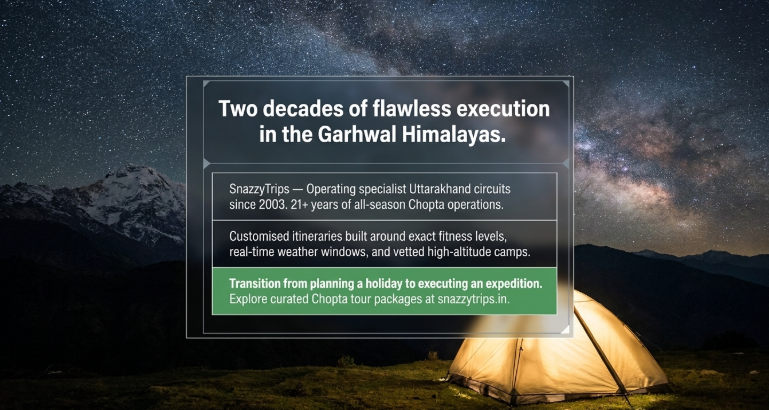
What should I look for in a travel agent for Chopta? A good Chopta travel agent should have direct experience with high-altitude Garhwal logistics — road conditions on the Ukhimath–Chopta route, tent camp quality at 2,680 metres, Tungnath temple timings, and Chandrashila summit weather windows. SnazzyTrips, a Uttarakhand-specialist DMC operating since 2003, has managed Chopta treks and temple circuits across every season and knows exactly what can go wrong — and how to prevent it.
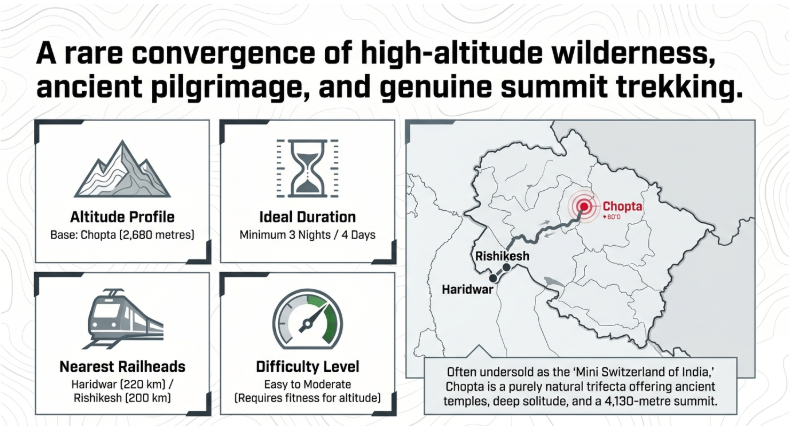
Quick Summary
| Detail | Info |
|---|---|
| Best Time to Visit | March–June and September–November |
| Ideal Duration | 3 nights / 4 days (min.) |
| Altitude | Chopta: 2,680 m |
| Difficulty Level | Easy to Moderate |
| Who It's For | Trekkers, pilgrims, couples, nature lovers, photographers |
| Nearest Railhead | Haridwar (220 km) / Rishikesh (200 km) |
| Why SnazzyTrips | 21+ years in Garhwal, all-season Chopta operations, curated circuits |
Introduction
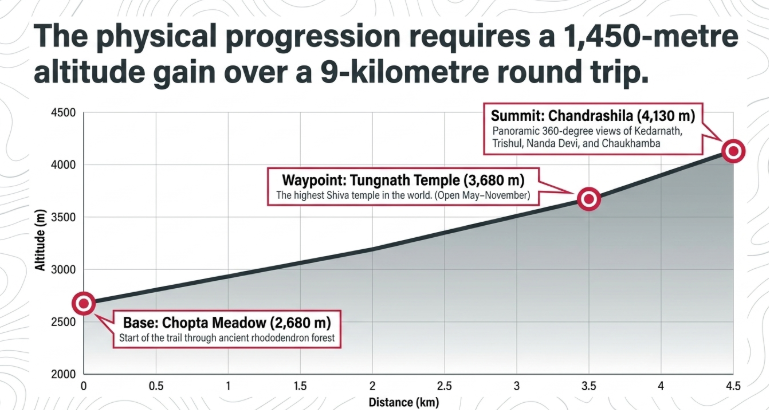
You are standing at 4,130 metres. The wind is sharp. The sky is the kind of blue that does not exist at lower altitudes. Below you, the entire Garhwal Himalaya unfolds — Kedarnath, Trishul, Nanda Devi, Chaukhamba — in one unbroken arc.
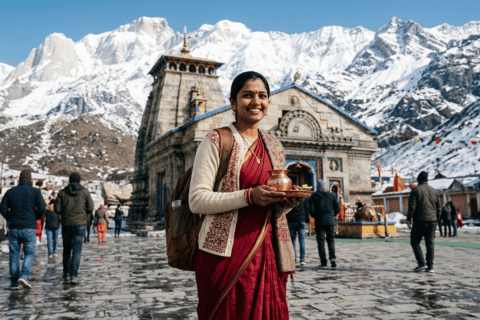
This is the Chandrashila summit. And the two-kilometre walk that brought you here, through ancient rhododendron forest and past the world's highest Shiva temple at Tungnath, is one of the most complete trekking experiences in all of Uttarakhand.
Chopta sits at 2,680 metres in the Rudraprayag district of Garhwal, roughly 200 km from Rishikesh. It is often called the "Mini Switzerland of India" — a label that undersells it, frankly. The meadows are greener, the temples older, and the solitude more genuine than any Swiss comparison suggests.
What makes Chopta unusual is that it offers three things in one place: high-altitude natural beauty, a major Shiva pilgrimage site at Tungnath, and a genuine summit trek to Chandrashila. That combination draws trekkers, pilgrims, and photographers simultaneously — which is exactly why operators like SnazzyTrips, a DMC in Uttarakhand since 2003, have seen demand for well-planned Chopta packages grow steadily year after year.
This guide is for travellers and travel agents trying to understand what a good Chopta trip actually involves — and what to look for before booking.
Why Chopta Is Not Like Other Uttarakhand Destinations
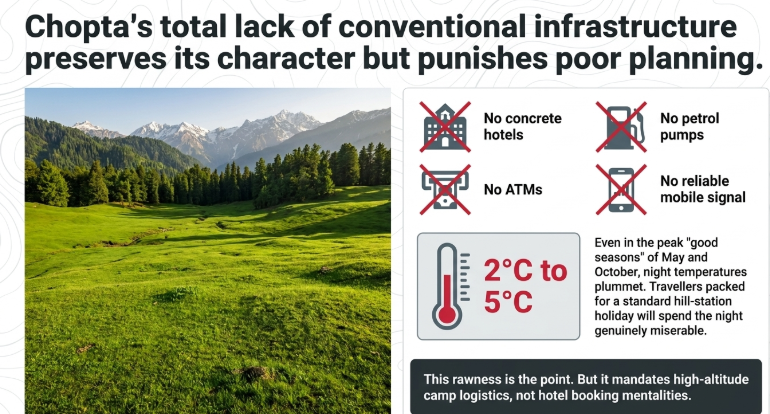
Most Uttarakhand hill stations have roads, markets, and hotels. Chopta has none of these in the conventional sense.
The "town" of Chopta is essentially a cluster of small tent camps and basic guesthouses along a ridge meadow. There is no market, no petrol pump, no ATM, and no reliable mobile signal on most networks. The road from Ukhimath is narrow, spectacular, and — after rain or snowmelt — genuinely challenging.
This is not a complaint. It is the point.
Chopta's underdevelopment is what preserves its character. The meadows stay green and uncluttered. The rhododendron forest on the Tungnath trail remains intact. The Chandrashila summit remains pristine. These are not things that survive heavy commercialisation.
But this rawness means that Chopta punishes poor planning more than most destinations. A traveller who books through a generic platform and arrives without the right camp, the right clothing, or the right departure timing from Delhi will have a genuinely difficult experience. A traveller who books with a specialist operator will have one of the best mountain trips of their life.
📍 Quick Fact: Tungnath temple at 3,680 metres is the highest Shiva temple in the world. It remains open from May to November and closes for winter due to heavy snowfall.
What a Good Chopta Travel Agent Actually Does
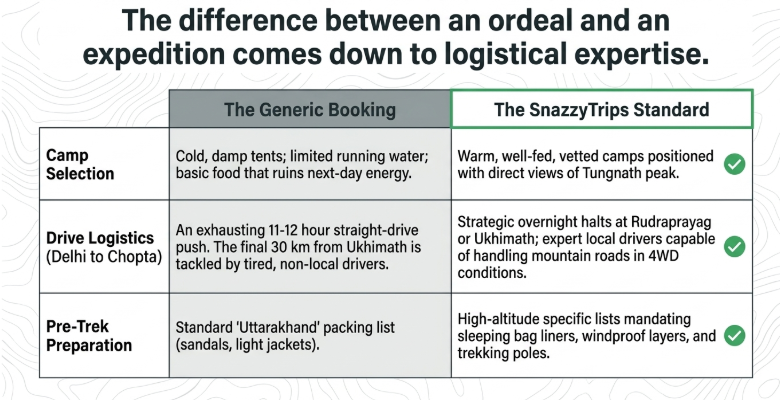
The difference between a good and a bad Chopta experience almost always comes down to operator knowledge. Here are the three areas where it matters most.
Camp and Accommodation Selection
Chopta has no proper hotels at the meadow level. Accommodation is either small basic guesthouses (limited running water, basic food) or tent camps of varying quality. The best camps are warm, well-fed, and positioned with direct views of Tungnath peak. The worst are cold, damp, and serve food that will ruin your trek the next morning.
A good travel agent knows which camps are actually operating in a given season, which ones have been recently upgraded, and which ones should be avoided. This is information that does not exist reliably on any booking platform — it comes from ground relationships.
Road and Weather Logistics
The route from Delhi to Chopta passes through Haridwar, Devprayag, Rudraprayag, and Ukhimath — a drive of approximately 11–12 hours. The final 30 km from Ukhimath to Chopta is a mountain road that requires a competent driver and often a 4WD vehicle in winter or early spring.
Weather at this altitude changes fast. An operator who monitors the forecast and adjusts departure timing accordingly — leaving Delhi the evening before rather than the morning of, for example — makes a material difference to the quality of the trek.
Tungnath and Chandrashila Sequencing
The Tungnath temple walk (3.5 km one way from Chopta) and the Chandrashila summit extension (1 additional km) need to be timed for morning starts. Cloud and mist typically roll in by 11 AM at this altitude, obscuring the summit views that are the whole point of the Chandrashila climb.
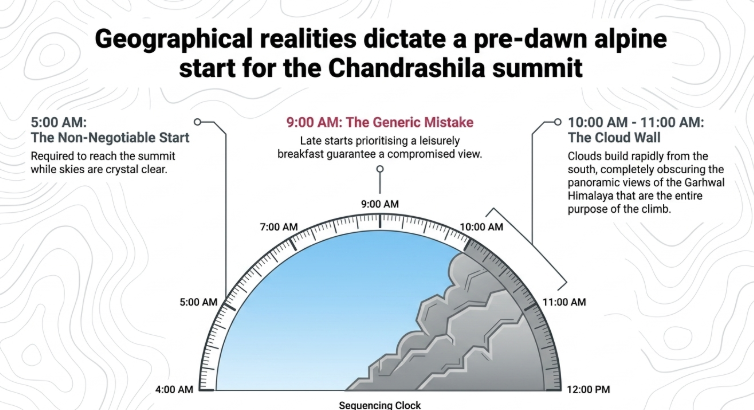
A good travel agent builds the itinerary around a 5 AM start for the summit day — not a 9 AM start because "breakfast needs to be served first." This sequencing decision alone separates operators who know Chopta from those who don't.
🧭 Traveler Tip: Start the Chandrashila trek no later than 5:30 AM for a clear summit. Clouds build from the south by 10 AM most days — especially in May, June, and October.
SnazzyTrips Insights
From our team at SnazzyTrips, operating Chopta circuits for 21+ years:
The most underestimated thing about Chopta is the cold. Even in May and October — technically "good season" — night temperatures at the meadow drop to 2–5°C. Travellers who pack for a "hill station" rather than a "high-altitude camp" spend the night genuinely miserable. We send every Chopta traveller a specific packing list that includes a sleeping bag liner, a windproof layer, and trekking poles for the Chandrashila ascent.
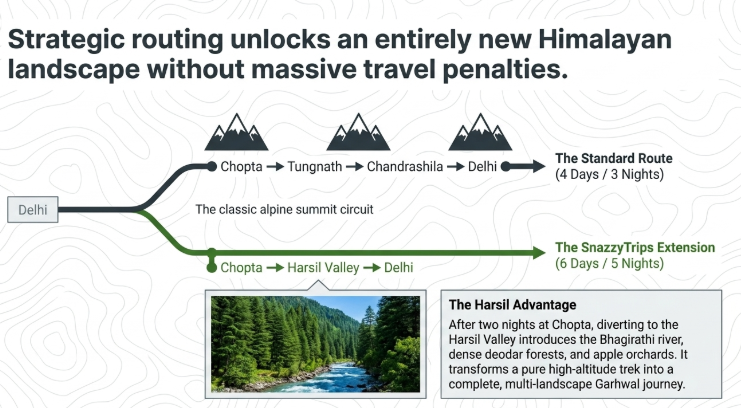
The second thing we've learned: the Harsil Valley extension is completely underused. After two nights at Chopta, heading to Harsil adds an entirely different landscape — the Bhagirathi river valley, apple orchards, dense deodar forests — without adding significant travel time. It makes a 6-day Garhwal circuit that feels genuinely complete.
For customised Chopta itineraries built around your fitness level and travel dates, explore our Chopta tour packages at snazzytrips.in.
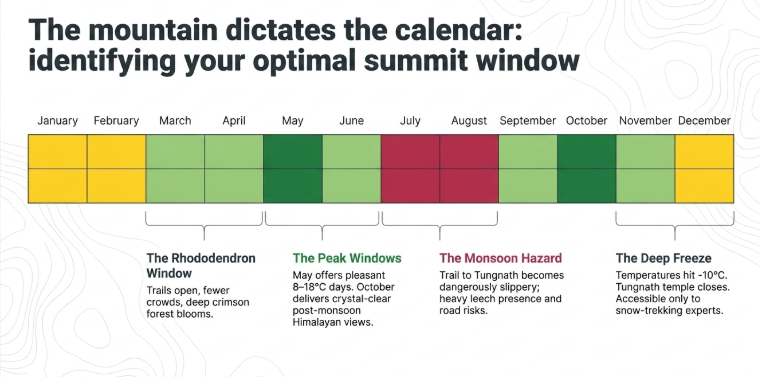
Best Time to Visit Chopta — Month by Month
| Month | Weather | Suitability | Notes |
|---|---|---|---|
| January | Heavy snow, -10°C nights | For snow enthusiasts only | Road access often blocked |
| February | Snow, -5 to 2°C | Difficult | Chopta fully snow-covered |
| March | Snow melting, 0–8°C | Good | Rhododendrons begin, fewer crowds |
| April | Cool, 5–14°C | Very Good | Rhododendron peak, trail opening |
| May | Pleasant, 8–18°C | Excellent | Best month overall, clear skies |
| June | Warm days, 12–20°C | Very Good | Green meadows, pre-monsoon clarity |
| July | Monsoon, rain | Avoid | Trail becomes slippery and dangerous |
| August | Heavy rain | Avoid | Road risk, leeches on trail |
| September | Post-monsoon, 8–16°C | Excellent | Crystal visibility, green landscape |
| October | Clear, 4–12°C | Excellent | Peak season, best Himalayan views |
| November | Cold, 0–8°C | Good | Thin crowds, first snowfall possible |
| December | Heavy snow, closing season | Only for experts | Tungnath temple closes |
May and October are the two peak months. March–April suits travellers who want rhododendron colour and fewer crowds. Avoid July–August without exception — the trail to Tungnath becomes genuinely hazardous in monsoon.
Sample Chopta Itineraries
| Package | Duration | Route | Starting Price |
|---|---|---|---|
| Chopta Tungnath from Delhi | 4 days / 3 nights | Delhi - Chopta - Tungnath - Delhi | Rs. 16,999/person |
| Chopta Tungnath Chandrashila Trek | 6 days / 5 nights | Delhi - Chopta - Tungnath - Chandrashila - Delhi | Rs. 19,999/person |
| Chopta + Harsil Valley | 6 days / 5 nights | Delhi - Chopta - Harsil Valley - Delhi | Contact for pricing |
The Chopta–Tungnath–Chandrashila circuit is the most complete single-destination Chopta experience. The Harsil Valley extension suits travellers who want a multi-landscape Garhwal trip. See our Chopta Tungnath tour package from Delhi and Chopta Tungnath Chandrashila trek for full itinerary details.
For those who want to combine forest, river valley, and alpine meadow in a single journey, our Chopta Harsil Valley tour from Delhi covers all three landscapes across six days.
📍 Quick Fact: The Chopta Tungnath Chandrashila trek covers approximately 9 km round trip from Chopta to Chandrashila summit, with a total altitude gain of around 1,450 metres.
Costs and What to Budget
| Item | Budget | Mid-Range | Premium |
|---|---|---|---|
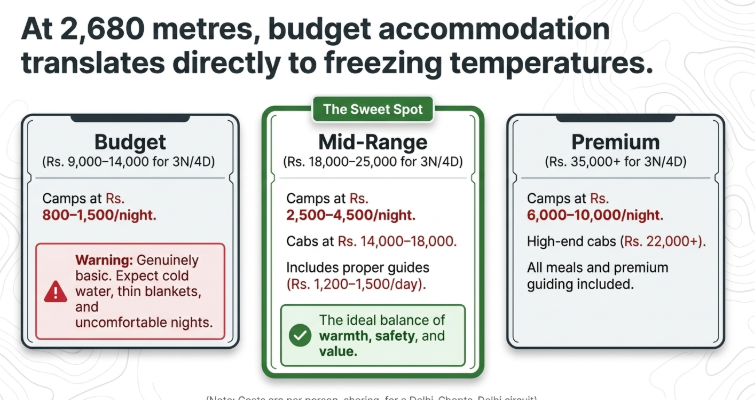
| Camp/accommodation (per night) | Rs. 800–1,500 | Rs. 2,500–4,500 | Rs. 6,000–10,000 |
| Meals (per day, per person) | Rs. 400–600 | Rs. 700–1,000 | Included in camp |
| Cab (Delhi–Chopta–Delhi) | Rs. 9,000–12,000 | Rs. 14,000–18,000 | Rs. 22,000+ |
| Trek guide (per day) | Rs. 800–1,000 | Rs. 1,200–1,500 | Included in package |
| Total 3N/4D (per person, sharing) | Rs. 9,000–14,000 | Rs. 18,000–25,000 | Rs. 35,000+ |
Budget options at Chopta are genuinely basic — cold water, thin blankets, simple food. If you are not an experienced camper, budget accommodation at Chopta altitude will be uncomfortable. Mid-range is the sweet spot for most travellers.
How to Choose a Chopta Travel Agent — 5 Things to Check
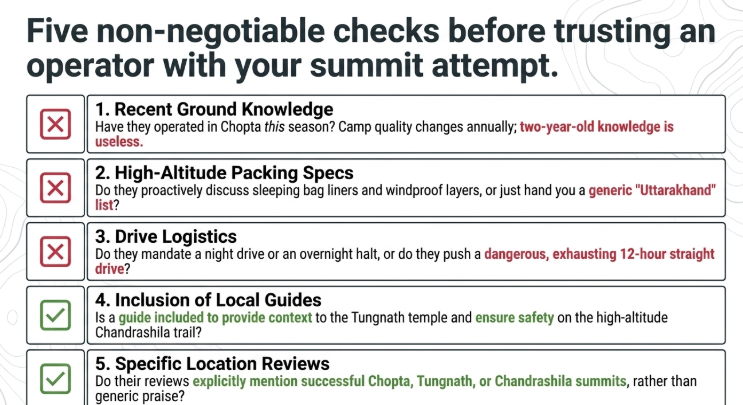
1. Have they operated Chopta recently? Chopta camp quality changes every season. An operator who last visited two years ago is working from outdated information. Ask when their last group was there and what camp they used.
2. Do they mention packing specifically? Any competent Chopta operator will proactively discuss clothing, sleeping gear, and trek footwear. If they hand you a generic "what to pack for Uttarakhand" list that includes sandals and light jackets, they have not thought about Chopta at 2,680 metres.
3. Can they handle the Delhi–Chopta drive logistics? The drive is 11–12 hours. A good operator will recommend a night drive or overnight halt at Rudraprayag or Ukhimath rather than a straight Delhi-to-Chopta push that arrives exhausted.
4. Do they include a trek guide? The Tungnath–Chandrashila trail is straightforward but high altitude. A local guide adds safety, context, and the temple knowledge that makes the Tungnath visit meaningful rather than just a waypoint. If your package does not include one, ask why.
5. Do they have Chopta-specific reviews? Ask for reviews that mention Chopta, Tungnath, or Chandrashila by name. General "great Uttarakhand trip" reviews tell you nothing about high-altitude competence. For a full framework on evaluating Uttarakhand operators, read our guide on choosing the best travel agent for Uttarakhand.
FAQ
Q: What is Chopta famous for? A: Chopta is famous for three things: the Tungnath temple — the world's highest Shiva temple at 3,680 metres — the Chandrashila summit trek with its 360-degree Himalayan panorama, and its alpine meadows that bloom with rhododendrons in spring. It is also one of the best winter snow destinations in Uttarakhand for travellers who are prepared for cold conditions. For a full list of experiences, read our guide on things to do in Chopta.
Q: How difficult is the Chandrashila trek? A: The Chandrashila trek is rated easy to moderate. The trail from Chopta to Tungnath (3.5 km) is a well-paved path suitable for most fitness levels. The extension from Tungnath to Chandrashila summit (1 km) involves a steeper rocky section that requires reasonable fitness and proper trekking shoes. The main challenge is altitude — 4,130 metres — not technical difficulty. Allow 4–5 hours round trip for the full summit route.
Q: Is Chopta accessible in winter? A: Chopta receives heavy snowfall from December to February. The road from Ukhimath is often blocked, and the Tungnath temple closes for winter. However, for experienced travellers with proper gear, a Chopta snow trip between January and March offers a completely different — and spectacular — experience. Always check road conditions 48 hours before departure and travel with a competent local driver.
Q: How do I reach Chopta from Delhi? A: The most common route is Delhi → Haridwar → Devprayag → Rudraprayag → Ukhimath → Chopta, a total drive of approximately 450 km taking 11–12 hours. SnazzyTrips recommends an overnight halt at Rudraprayag or Ukhimath on the way up, rather than a single-day push from Delhi. The nearest railway station is Haridwar (220 km from Chopta).
Q: What is the best Chopta package for first-time trekkers? A: The Chopta Tungnath tour package from Delhi at Rs. 16,999 per person is the ideal starting point. It covers the meadow stay, the Tungnath temple walk, and the Chandrashila summit in a 4-day window — enough to experience everything Chopta offers without overexerting a first-time trekker.
Q: Can I combine Chopta with Auli or Kedarnath? A: Yes — Chopta pairs naturally with both. Auli is approximately 90 km from Chopta and adds a ski resort or cable car experience to the itinerary. Kedarnath is approximately 75 km away and adds a major pilgrimage experience. Both combinations work within a 7–9 day Garhwal circuit. SnazzyTrips can build a custom multi-destination itinerary based on your travel dates and fitness level.
Q: Is a permit required for the Chandrashila trek? A: No permit is currently required for the Chandrashila trek from Chopta. The trail passes through the Kedarnath Wildlife Sanctuary, but entry for the standard Tungnath–Chandrashila route does not require a separate permit. A local guide is recommended but not mandatory. Rules can change seasonally — confirm with your operator before travel.
Travel Packages